AEO vs SEO: Why Answer Engine Optimization Is the Future of Search Marketing
I had a minor crisis three months ago.
One of our best-performing articles was still ranking #2 on Google, pulling in about 500 visits every month. But something had changed. The conversions had fallen off a cliff. Traffic stayed steady, but leads basically stopped.
I couldn't figure it out. The page was still ranking. People were still visiting. But they weren't converting anymore.
Then I tried something. I asked ChatGPT the exact question our article was supposed to answer.
It gave me a detailed, comprehensive response pulling from three different sources. Showed me specific recommendations, explained the pros and cons, even included some statistics I recognized from industry reports.
Not one of those sources was us.
That's when I understood what was happening. Our perfect SEO article had become irrelevant, not because it ranked poorly, but because people were getting their answers from AI instead. They weren't visiting our site anymore because they didn't need to.
We weren't competing with other websites. We were competing with AI-generated answers that never sent users anywhere at all.
Welcome to the era of Answer Engine Optimization.
What's really changing (and why it matters now)
Let's start with what AEO actually is, because there's a lot of confusion about this.
Answer Engine Optimization is the practice of optimizing your content so AI platforms like ChatGPT, Perplexity, Claude, and Google AI Overviews cite your brand as a trusted source when answering questions.
It sounds similar to SEO, and there's definitely overlap. But the fundamental goal is different in a way that changes everything.
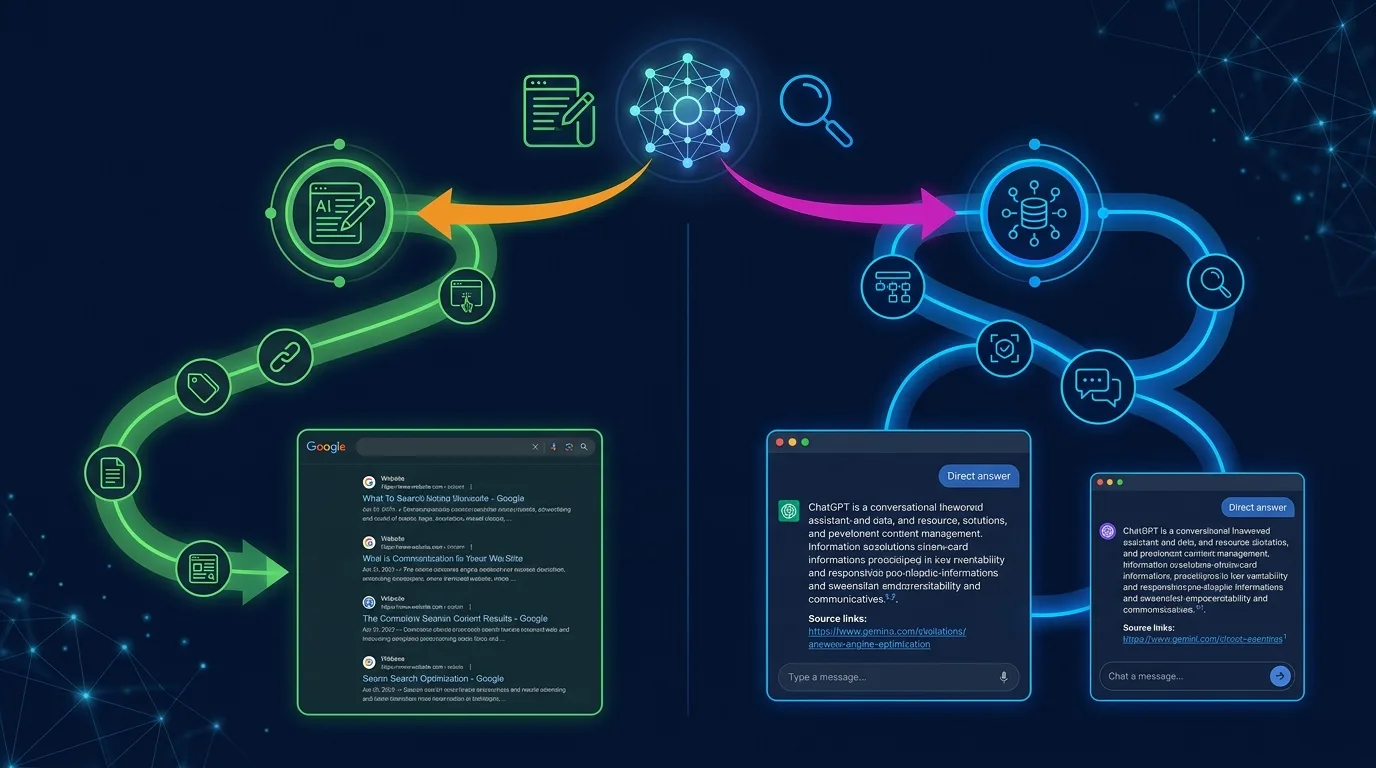
With traditional SEO, you're trying to rank high in search results so people click through to your website. Success means traffic. The whole point is to get someone to visit your page.
With AEO, you're trying to get the AI to extract your information and include it directly in the answer. Success means being cited. And here's the weird part: sometimes the person never visits your site at all, but you still influenced their decision because the AI mentioned your brand.
According to WordPress VIP's analysis, answer engines are designed to retrieve and summarize content directly for the user. The goal isn't search visibility anymore - it's answer visibility.
Think about your own behavior. When you ask ChatGPT something, how often do you click through to the sources? Sometimes, maybe. But often the AI's answer is enough. You got what you needed without ever leaving the chat interface.
That's the shift. And if your brand isn't part of that AI-generated answer, you've lost the opportunity completely. You can't recover from invisibility.
The numbers that should terrify you (or excite you)
Let me give you some context for why this matters right now, not five years from now.
Over 400 million people use OpenAI products every single week. That's not a projection - that's current usage. Microsoft saw a 4x increase in Bing mobile app downloads after adding AI chat features. And Gartner predicts that by the end of 2026, 25% of organic search traffic will shift from traditional search to AI chatbots and virtual assistants.
One quarter of all search traffic. In one year.
I'm seeing this in our own analytics. We're getting more combined traffic from chatgpt.com, perplexity.ai, and claude.ai than we get from Bing. And those AI referrals convert at 2.3x the rate of regular organic traffic because people trust the AI recommendation.
But here's what keeps me up at night: AI traffic is just what we can measure. It's just the visible part.
The invisible part is bigger. It's all the times someone asks ChatGPT for a recommendation and takes action without ever clicking a link. They just act on whatever the AI told them. If your competitor gets cited and you don't, you lost a customer you never knew existed.
Traditional analytics can't capture that opportunity cost. You don't see "people who never considered us because ChatGPT didn't mention us" in your dashboard. But it's happening thousands of times per day.
How the strategies actually differ in practice
Let me break down the real, concrete differences in how you optimize for each.
For keyword strategy, traditional SEO focuses on high-volume keywords and their variations. You research "project management software" and find it has 40,000 monthly searches, so you optimize for that phrase and related terms.
AEO focuses on the full questions people actually ask AI. Not just "project management software" but "what's the best project management software for remote teams with less than 20 people?" The complete, conversational query.
People don't talk to ChatGPT the way they type into Google. They ask full questions like they're talking to a human expert. Your content needs to match that natural language pattern.
Content structure is where the differences really show up. For SEO, you optimize title tags, meta descriptions, URL structure, header hierarchy. You build internal links and make sure your navigation is crawlable.
For AEO, you need answer capsules - those brief, direct answers immediately under question-based headers. You need FAQ formats. You need content structured so AI can extract clean, self-contained answers from each section.
I can take the same information and structure it two different ways. The SEO version might rank well but never get cited by AI. The AEO version might rank less well initially but get cited constantly. They're optimizing for different outcomes.
Technical optimization diverges too. SEO prioritizes page speed, mobile-friendliness, crawlability, and indexation. All important fundamentals.
AEO adds another layer: schema markup becomes essential, not optional. Structured data, entity definitions, video transcripts - anything that helps AI understand what your content is actually about.
Then there's measurement. SEO tracks rankings, traffic, click-through rates, conversion rates. Standard stuff that every marketer understands.
AEO requires different metrics. Citation rate - how often you appear in AI answers. Brand mentions in AI responses. AI referral traffic. These metrics barely existed two years ago, and most analytics platforms don't track them automatically.
We had to build custom tracking just to measure whether our AEO efforts were working. Traditional SEO tools had no way to tell us if ChatGPT was citing our content.
The content that wins in both worlds
Here's the good news: you don't have to choose between SEO and AEO. The best content strategy serves both simultaneously.
The trick is understanding which tactics satisfy both channels versus which are specific to one.
Answer capsules are your highest-leverage tactic because they work for everything. When you put a clear, concise answer immediately under a question-based heading, that helps SEO (Google loves featured snippets) and AEO (easy extraction for AI) and user experience (people get quick answers).
It's a universal win.
The format looks like this: question-based H2 heading, immediately followed by a 30-50 word answer that directly addresses the question, then expansion with details and examples.
That structure performs well across every channel we've tested.
Original data dominates everywhere. Google rewards unique content. AI models need distinct sources to cite. Users want information they can't find anywhere else. Whether someone discovers you via search or via ChatGPT, original research gets attention.
We published a study on AI citation patterns last quarter. It started ranking on Google within two weeks. ChatGPT started citing it within three weeks. Same content, multiple channels, all because it was genuinely original.
Schema markup powers both traditional search and AI understanding. It helps Google create rich snippets in search results. It helps AI models extract structured information about your content. One technical implementation, dual benefits.
According to LadyBugz's 2026 guide, schema markup is one of the most underutilized tactics that simultaneously improves traditional and AI search performance. Most companies just aren't implementing it properly.
Why your current SEO strategy isn't enough
Let me be direct: most companies are still optimizing for 2019-era SEO while completely ignoring how AI models evaluate content.
I reviewed the content strategies of about fifty B2B SaaS companies last month. Forty-seven were using pure SEO playbooks with zero AEO considerations. They're obsessing over keyword density and backlink profiles while ignoring whether AI can even extract answers from their content.
The three companies that were incorporating AEO? They were getting cited regularly by ChatGPT and Perplexity. The other forty-seven? Basically zero AI citations despite having strong traditional SEO metrics.
That gap is only getting wider.
Here's what you need to add to your existing SEO strategy without abandoning what already works:
First, convert your best-performing content to question-and-answer format. You don't need to change the information - just reorganize it so each section answers a specific question clearly.
Second, add entity definitions immediately when you mention specialized concepts. Don't assume AI already knows what you're talking about. When you reference "Reddit karma" or "schema markup" or whatever jargon is normal in your industry, define it right away.
Third, implement FAQ schema on your key pages. Service pages, product pages, educational content - anywhere you're answering common questions, add the structured data that makes those Q&A pairs machine-readable.
Fourth, build topic clusters instead of isolated keyword targets. AI models favor sources that demonstrate comprehensive expertise across a subject area. Five deeply connected articles about related aspects of a topic perform better than five disconnected articles about random keywords.
Measuring what actually matters
Traditional SEO tools don't measure AI citations. You need new approaches.
Start with manual testing. It sounds primitive, but it's the most accurate method available right now.
Create a spreadsheet with 20-30 questions that represent your core expertise areas. Once per week, ask those exact questions to ChatGPT, Perplexity, Claude, and Google AI Overviews. Document whether your brand appears in the answers and in what context.
We spent three months doing this manually before we built any automation. It was tedious, but it gave us incredibly clear insight into our AI visibility.
You want to track not just whether you're mentioned, but how you're positioned. Are you being recommended as the primary solution? Mentioned as an alternative? Cited for data or research? The context matters as much as the mention itself.
Also set up a dedicated channel in Google Analytics 4 for AI referral traffic. Create a custom channel grouping that captures traffic from chatgpt.com, perplexity.ai, claude.ai, and similar domains. Track it separately from traditional organic traffic so you can measure trends.
We saw our AI referral traffic grow 400% over six months while traditional organic traffic stayed basically flat. That data convinced our leadership to invest seriously in AEO. Without that tracking, we never would have seen the opportunity.
Create your own citation rate metric: the number of target queries where you're cited divided by total queries tested, expressed as a percentage.
If you test 50 relevant questions and your brand appears in 15 AI responses, your citation rate is 30%. Track this weekly. A rising citation rate tells you your optimization efforts are working, even if you can't directly measure every business outcome.
The mistakes that waste your AEO efforts
I've watched smart marketers make predictable mistakes with AEO. Let me save you some pain.
First mistake: thinking it's just about stuffing "AI-friendly" keywords into your content. That's not how this works. AI models are trained on high-quality content and can recognize keyword stuffing or unnatural language. The content has to genuinely answer questions better than alternatives.
Second mistake: abandoning traditional SEO because you're excited about AEO. Don't do that. Google still drives massive traffic and isn't going anywhere soon. You need both. According to HubSpot's analysis, the most successful brands maintain strong performance in both traditional and AI search.
Third mistake: gating all your best content behind signup forms. AI models typically can't access content that requires authentication. If everything valuable is behind a wall, AI will never cite you. You need at least some premium ungated content.
Fourth mistake: optimizing purely for AI extraction without considering human readers. Content that's structured only for machines reads terribly for people. You still need narrative flow, personality, and readability. The best AEO content satisfies both audiences.
Fifth mistake: expecting immediate results. AEO takes time, just like SEO. You won't see ChatGPT citations next week. Plan for 2-3 months of consistent optimization before meaningful results show up.
Your 90-day implementation roadmap
You don't need to overhaul everything at once. Here's a realistic plan.
Days 1-30 are about assessment and foundation. Manually test your current visibility across major AI platforms. Pick ten questions that matter to your business and ask them to ChatGPT, Perplexity, and Claude. See where you stand. Set up tracking in Google Analytics for AI referral traffic. Implement basic FAQ schema on your main pages.
That first month is about understanding your current state and building measurement systems. Don't skip this. You can't improve what you don't measure.
Days 31-60 focus on optimizing existing content. Take your five best-performing articles and convert them to Q&A format with clear answer capsules. Add entity definitions wherever you use industry jargon. If you can, create one piece of original research - a survey, analysis, or case study that provides unique data.
Build out comprehensive topic coverage in your core expertise area. Don't just have one article about project management - have five articles covering different aspects that all link together into a cohesive knowledge base.
Days 61-90 are about testing and iteration. Retest your target queries weekly. Track which content structure generates citations versus which doesn't. When something works, document why and expand that approach to more content. When something fails, figure out what went wrong.
That's it. Ninety days of focused effort, and you'll know whether AEO can drive meaningful results for your business. Most companies won't do this because it requires patience and consistent execution. That's your opportunity.
The answer to "which one do I need"
Here's the truth: asking "AEO vs SEO" is like asking "mobile vs desktop" five years ago. They're both essential channels with different dynamics, and you need a strategy for both.
Traditional SEO isn't dying. Google processes billions of searches every day, and plenty of those searches still result in link clicks. People still browse websites. Traffic still converts. You can't abandon that.
But AEO represents where search behavior is heading. Over 400 million people already trust AI for answers instead of scrolling through search results. That number will only grow as AI becomes more integrated into how people find information.
The winning strategy is hybrid optimization that serves both traditional search engines and AI answer engines. You want to create content that ranks on Google AND gets cited by ChatGPT. Content that targets keywords AND answers questions. Content that builds backlinks AND earns AI recommendations.
At CiteEngine, this is the approach we've developed for our clients. We don't choose between SEO and AEO. We build strategies that win in both traditional search and AI-generated answers, because the companies that master both won't just survive the shift to AI search - they'll dominate it.
The question isn't whether to invest in AEO. It's whether you can afford to let your competitors figure it out first while you're still stuck optimizing for 2019-era search engines.
The shift is happening now. The only question is whether you'll be ready.
Frequently Asked Questions
These are the questions buyers ask ChatGPT, Claude, and Perplexity when researching this topic.
Q: What is Answer Engine Optimization (AEO)?
A: AEO is the practice of structuring content so AI models like ChatGPT, Claude, and Perplexity cite your brand when answering user questions. Unlike traditional SEO which targets search rankings, AEO targets AI-generated responses.
Q: How is AEO different from SEO?
A: SEO optimizes for human searchers clicking blue links in Google results. AEO optimizes for AI models that synthesize answers and cite sources directly. AEO requires structured Q&A content, authoritative third-party mentions, and citation-ready formatting.
Q: Do I need both AEO and SEO in 2026?
A: Yes, but AEO is becoming increasingly important. An estimated 30-40% of searches now involve AI-generated responses. Brands invisible to AEO miss buyers who rely on ChatGPT and similar tools for purchase research.
Q: How long does it take to see results from AEO?
A: Most brands see measurable improvement in AI citation frequency within 60-90 days of systematic AEO implementation. First visible results typically appear within 30 days of publishing citation-optimized content.
Q: What is the fastest way to get started with AEO?
A: Run an AI visibility audit to see how often your brand currently appears in ChatGPT, Perplexity, and Google AI responses. Identify your top 10 buyer questions. Publish structured Q&A content answering those questions.
Want AI to recommend your brand?
Get a free AI visibility audit: where you show up in ChatGPT, Claude and Perplexity today, and where your competitors do. No calls required.