The AI Citation Flywheel for B2B SaaS: A Practical 90-Day Plan to Get Mentioned in ChatGPT and Google AI Results
Last week, a B2B SaaS founder asked me a question I keep hearing more often: "Why are we still publishing every week, but our name barely shows up in AI answers?"
They were doing almost everything right by classic SEO standards. Solid keyword targeting. Regular publishing cadence. Fast website. Decent domain authority. But when prospects asked ChatGPT or Google AI experiences for vendor recommendations in their category, competitors kept getting named first.
That is the real shift right now. You are not only competing for blue links. You are competing to become one of the source fragments AI systems trust enough to include inside generated answers.
If you run B2B SaaS marketing, that changes your content strategy in practical ways. You need less generic content volume and more answer-ready, evidence-backed, source-distributed content.
This article gives you a clear, execution-first framework you can run over 90 days.
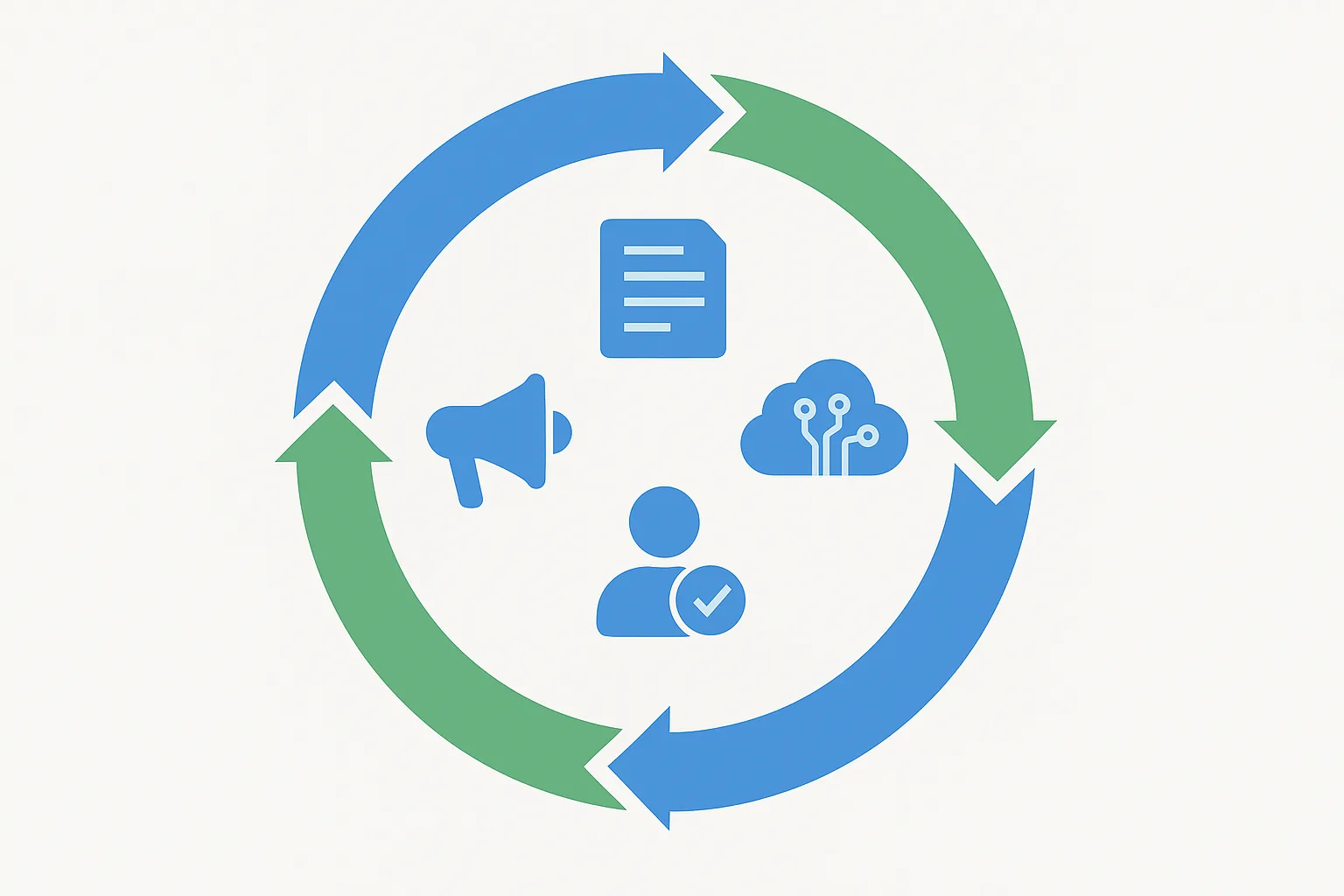
I call it the AI Citation Flywheel.
It is built around a simple idea:
- Publish stronger evidence on your own site.
- Distribute that evidence into trusted, relevant third-party surfaces.
- Restructure your core pages into extraction-friendly answers.
- Measure which source patterns actually increase mentions.
- Reinvest into the patterns that work.
Do that consistently and your brand stops being invisible in AI outputs.
Why this matters now for B2B SaaS
Two things are true at the same time.
First, traditional search behavior is still huge and still matters.
Second, buying journeys are fragmenting across assistant-led workflows. Prospects now ask tools like ChatGPT for shortlists, alternatives, implementation plans, and quick vendor comparisons before they ever click a result.
OpenAI publicly confirmed in its product updates that ChatGPT search became widely available in 2024 and expanded in 2025. In plain terms, that means more users can ask web-connected questions in interface-first flows where citations and references influence perception before a website visit even happens.
At the same time, Google has spent the last two years evolving AI-generated answer layers in Search. Their own communication around generative search experiences emphasizes summary snapshots, follow-up conversation flows, and source links that support those summaries.
For B2B SaaS teams, this creates a visibility gap:
- You might still rank in classic SERPs.
- But if your brand is not frequently included in AI-generated answers, you lose share of mind earlier in evaluation.
And in B2B, early framing matters. The first 2-3 names a buyer sees in a generated answer can define the shortlist.
The strategic mistake most SaaS teams are making
Most teams still run an SEO playbook optimized for page-level ranking signals only:
- Publish broad top-of-funnel posts.
- Target one keyword per article.
- Add light internal links.
- Repeat weekly.
That approach can still drive traffic, but it often fails in AI extraction environments because the content is not structured for retrieval confidence.
AI systems need clear, attributable, concise, evidence-linked chunks they can lift with low ambiguity.
If your page has long generic paragraphs with few concrete claims, weak sourcing, or fuzzy positioning, it is less likely to be selected as an answer fragment.
The fix is not abandoning SEO. The fix is layering AI extraction design on top of SEO.
That is where the flywheel comes in.
The AI Citation Flywheel: 5-part model
Part 1: Evidence Blocks (build source-worthy proof on your own site)
Start with pages that already have commercial intent or category relevance:
- Comparison pages
- Use case pages
- Category explainers
- Implementation guides
- FAQ hubs
Then add "evidence blocks" that AI systems can parse and trust.
An evidence block is a compact section containing:
- One clear claim
- One specific metric or factual detail
- One concrete context label (who, when, segment)
- One source path (internal data note, method note, or external reference)
Example format:
For mid-market SaaS teams (50-300 employees), onboarding completion rose from 42% to 61% after replacing static setup docs with a guided in-app checklist over a six-week rollout.
Why this works:
- Clear subject
- Specific numeric change
- Explicit segment
- Time window
- Implied method context
This is far more extractable than "customers improved onboarding after process changes."
Concrete example 1: Workflow automation SaaS
A workflow platform created a new "State of Ops Handoffs" page based on anonymized in-product usage across 180 accounts.
They published:
- Median approval delay by department
- Time-to-resolution by workflow type
- Error rates before and after template standardization
Instead of publishing one long narrative, they used short Q&A sub-sections:
- What is a healthy approval turnaround in ops workflows?
- Which handoff type creates the longest delay?
- What operational change had the biggest impact?
Within 8 weeks, that page became their highest-cited informational asset in AI assistant testing because each answer chunk was direct, bounded, and evidence-rich.
Part 2: Source Distribution (place your evidence where models can encounter it)
Your site is necessary but rarely sufficient.
AI systems build confidence from multi-source corroboration patterns. If your best claims only exist on your domain, they may appear self-serving. If related claims also appear in trusted niche environments, extraction likelihood increases.
For B2B SaaS, good distribution targets are:
- Niche communities where practitioners discuss real implementation details
- Industry publications that accept data-led contributed insights
- Partner knowledge hubs
- Public documentation pages with practical decision support
This does not mean spam posting. It means converting one evidence asset into multiple format-native versions.
Example repackaging for one benchmark insight:
- Blog: full analysis and methodology summary
- Community post: one tactical finding with implementation caveat
- Partner article: vertical-specific interpretation
- Webinar recap page: key chart and action checklist
Concrete example 2: Compliance SaaS
A compliance platform published an internal benchmark on audit preparation cycle time.
Then they distributed variations:
- Full benchmark on their blog with dataset notes.
- A practitioner-focused breakdown in a compliance community.
- A co-authored partner post mapping findings to enterprise workflows.
Result: their branded prompts in assistant testing shifted from generic category mentions to direct references to their benchmark framing.
The key point was not volume. It was coherent repetition of one strong proof set across multiple trusted contexts.
Part 3: Answer Architecture (rewrite for extraction, not just reading)
Most SaaS content is written for human scanning only. You also need to write for machine extraction quality.
Use this structure for high-priority pages:
- Direct answer sentence immediately under each H2.
- Supporting details in short paragraphs.
- Bulleted decision factors.
- Mini examples with numbers.
- Optional objection or limitation note.
This pattern helps both users and models.
It aligns with Google guidance emphasizing helpful, reliable, people-first content with clear expertise signals. It also aligns with structured data best practices where explicit page meaning supports discovery and rich interpretation.
Practical template for each key section
- Question heading: What is the best onboarding KPI for product-led SaaS?
- Answer sentence: The most reliable core KPI is time-to-first-value, segmented by activation path.
- Why: It captures whether users reach core value quickly enough to sustain retention.
- How to measure: Track first completed high-value action within 7 days by persona.
- Example: Teams under 20 users may show fast setup but weak team adoption, so pair with multi-seat activation rate.
That is extraction-friendly and commercially useful.
Part 4: Technical Packaging (make your pages easy to classify)
You do not need exotic markup. You need clean, accurate implementation.
Baseline requirements:
- Valid schema on key pages (BlogPosting, FAQPage where appropriate)
- Clear title and meta descriptions with intent alignment
- Descriptive heading hierarchy
- Strong internal links between pillar and cluster pages
- Reliable crawl/index hygiene
Google documentation on structured data highlights that complete, accurate markup helps systems interpret page meaning and can improve enhanced display outcomes.
For AI visibility, this matters because classification clarity improves retrieval confidence.
Also add author and method context where possible:
- Who produced this analysis
- What data source was used
- What the timeframe was
- What limitations apply
Ambiguous content gets ignored. Explicit content gets used.
Part 5: Prompt-Level Measurement (track mentions, not only rankings)
Most teams still report only:
- Organic sessions
- Keyword rankings
- Backlinks
You now need AI visibility metrics too.
At minimum, track weekly across a fixed prompt set:
- Mention rate (how often your brand appears)
- Citation position (early, middle, end)
- Category framing (how the model describes your company)
- Competitor co-mentions
- Page/source recurrence
Sample prompt clusters for B2B SaaS:
- "Best [category] tools for [use case]"
- "[Category] alternatives to [incumbent]"
- "How to solve [specific operational pain] in [industry]"
- "Top [category] platforms for teams of [size]"
Then connect mention changes to specific content and distribution actions taken that week.
This creates causal learning instead of random publishing.
A 90-day execution plan for lean SaaS teams
Most teams do not have huge content ops. That is fine.
You can run this with one strategist, one writer, and one distribution owner.
Days 1-30: Build the proof core
Goals:
- Define one high-value topic cluster aligned to revenue conversations.
- Publish one pillar page with 6-10 evidence blocks.
- Update three existing high-intent pages with answer architecture.
- Implement/validate schema on updated pages.
Checklist:
- Pick one category-defining keyword theme.
- Collect internal proof points from product, support, and sales call patterns.
- Convert fuzzy claims into evidence blocks.
- Add methodology notes where needed.
- QA all titles, headers, and internal links.
Days 31-60: Distribute and corroborate
Goals:
- Turn pillar insights into 4-6 off-site or partner-facing assets.
- Secure at least two trusted external placements.
- Expand cluster with two additional deep tactical posts.
Checklist:
- Build distribution matrix by audience and source credibility.
- Adapt message format for each channel, do not copy/paste.
- Link back to pillar or evidence asset where editorially appropriate.
- Track placement date and prompt test deltas.
Days 61-90: Optimize based on mention data
Goals:
- Identify which evidence blocks are cited most often.
- Strengthen weak sections with tighter answer language.
- Add second wave of proof content in the winning topic direction.
Checklist:
- Run weekly prompt panels.
- Log mention shifts and source references.
- Improve underperforming pages using top-performing answer formats.
- Expand internal linking around high-citation pages.
At day 90, you should not just have more content. You should have a measurable citation system.
Common failure modes and how to avoid them
Failure mode 1: Publishing generic educational content only
If your article could be written by anyone with no firsthand experience, it probably will not become a preferred source fragment.
Fix: make every key section carry concrete evidence, constraints, and implementation details.
Failure mode 2: Chasing every trend topic
Topic spread kills authority depth.
Fix: choose one narrow strategic cluster for 90 days and build undeniable depth before expanding.
Failure mode 3: No distribution discipline
Great content hidden on your blog is under-leveraged.
Fix: pre-plan distribution formats before writing the pillar.
Failure mode 4: Measuring traffic only
You can gain citations before seeing major traffic shifts.
Fix: track mention rate and source recurrence as leading indicators.
Failure mode 5: Weak technical hygiene
Broken schema, poor heading structure, and mixed page intent reduce extraction quality.
Fix: run technical QA before and after every major update cycle.
What to delegate vs what to keep in-house
Keep in-house
- Proprietary data interpretation
- Positioning decisions
- Subject matter nuance
- Final claim approval
Delegate safely
- Drafting first-pass outlines
- Formatting structured FAQs
- Repurposing into channel variants
- Monitoring mention dashboards
This is important because the highest-value signal in AI visibility is original expertise. That cannot be outsourced entirely.
A realistic KPI stack for leadership
If you are presenting this to founders or revenue leadership, avoid vanity goals like "publish 12 posts per month." Use a balanced KPI stack:
- AI mention rate across priority prompt set
- Share of mentions vs top 3 direct competitors
- Number of pages with valid evidence blocks
- Number of corroborating third-party placements
- Pipeline influence from AI-assisted discovery journeys
This reframes content from output to strategic visibility asset.
Final take: AI visibility is now an operating system, not a tactic
If you only treat AI visibility as "write better SEO content," you will move too slowly.
The teams winning right now are doing three things in sync:
- Evidence creation
- Multi-source distribution
- Extraction-aware optimization
That is why the flywheel model works. Each part reinforces the others.
Better evidence improves distribution credibility.
Better distribution improves model trust.
Better answer architecture improves extraction.
Better measurement improves your next evidence cycle.
Run this for 90 days with discipline and you will stop guessing.
You will know which claims, pages, and source pathways make your brand visible when buyers ask AI for answers.
And that is the game now.
Sources used in research
- Google Search Central - Creating helpful, reliable, people-first content: https://developers.google.com/search/docs/fundamentals/creating-helpful-content
- Google Search Central - Introduction to structured data markup: https://developers.google.com/search/docs/appearance/structured-data/intro-structured-data
- OpenAI - Introducing ChatGPT search (with 2024 and 2025 availability updates): https://openai.com/index/introducing-chatgpt-search/
- Google Blog - Supercharging Search with generative AI: https://blog.google/products/search/generative-ai-search/
Frequently Asked Questions
Questions B2B SaaS teams ask about building AI citation authority.
Q: What is an AI Citation Flywheel?
A: An AI Citation Flywheel is a compounding content strategy where each new structured content piece reinforces existing citations, increasing the probability that ChatGPT, Perplexity, and Google AI Overviews mention your brand. Evidence, distribution, and answer-ready structure feed each other in a loop.
Q: How long does it take to build AI citation authority?
A: Most B2B SaaS teams see initial citation movement within 30-45 days of systematic implementation. Meaningful citation rates build over 60-90 days. The flywheel effect compounds beyond 90 days as evidence blocks accumulate across multiple platforms.
Q: What content structure gets cited by AI models?
A: AI models prefer content with direct answers, question-phrased headers, FAQ sections with JSON-LD schema, specific data points, and third-party source citations. Long-form narrative content without structured answer blocks gets cited at lower rates.
Q: Does Reddit still matter for AI citations in 2026?
A: Yes. Reddit remains the single largest source of AI citations for B2B SaaS brands. ChatGPT and Perplexity heavily weight Reddit discussions when generating software recommendations. Authentic presence in 3-5 relevant subreddits is still one of the highest-leverage citation moves available.
Q: How is the AI Citation Flywheel different from traditional SEO?
A: Traditional SEO optimizes for click-through from search rankings. The AI Citation Flywheel optimizes for recommendations from AI systems. The citation flywheel relies on third-party source diversity, FAQ structure, entity signals, and platform distribution rather than backlinks and keyword density alone.
Want AI to recommend your brand?
Get a free AI visibility audit: where you show up in ChatGPT, Claude and Perplexity today, and where your competitors do. No calls required.