How to Get Cited by ChatGPT in 2026: The Complete Guide
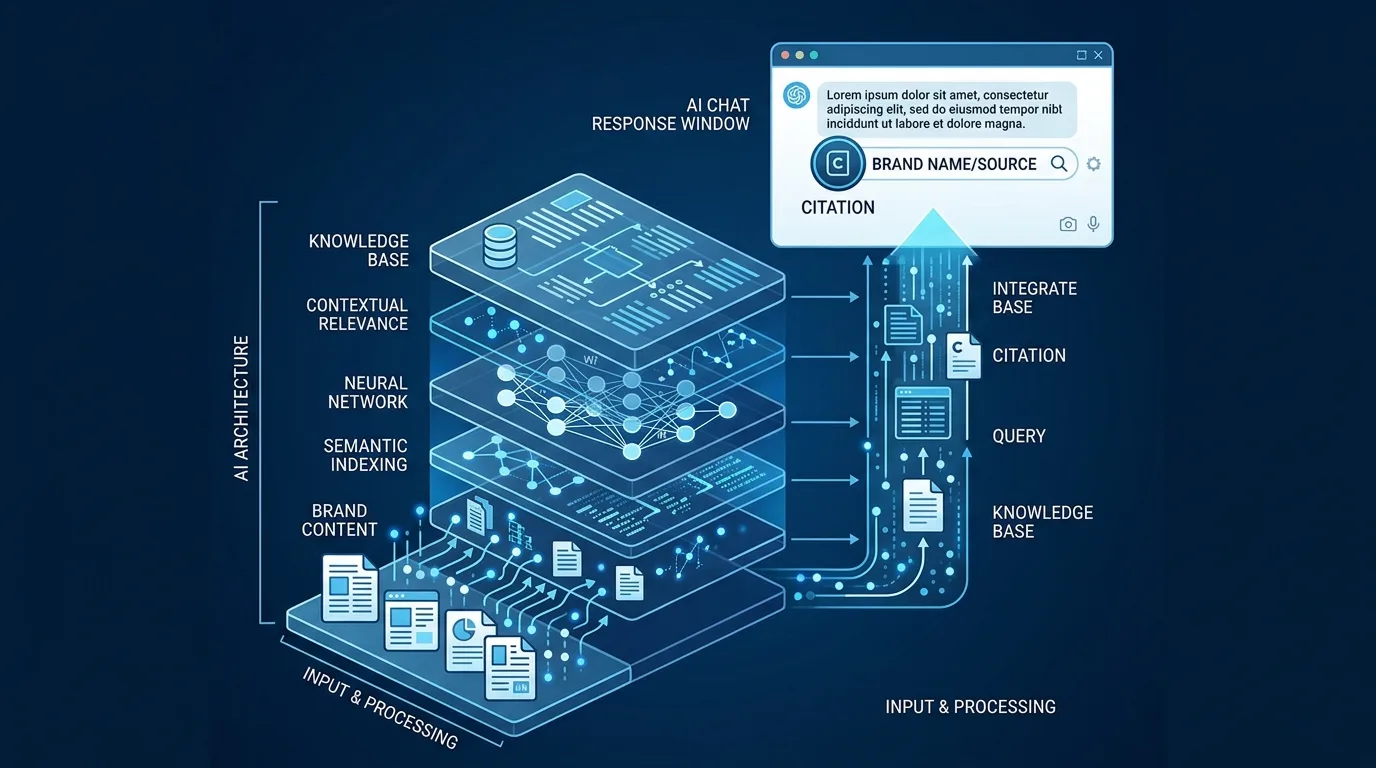
I spent three hours last Tuesday doing something that would've seemed crazy a year ago.
I was asking ChatGPT the same questions over and over, but with slight variations. "What's the best CRM for small teams?" "Which CRM should a startup use?" "Recommend a CRM for 10-person companies."
I was testing whether our client's brand would show up in the answers. Out of 47 different queries, ChatGPT cited them exactly three times. Their competitor? Showed up in 31 of those same queries.
That's a problem. Because over 400 million people now use ChatGPT every week, and if your brand isn't appearing in those AI-generated answers, you're essentially invisible to a massive chunk of your potential market.
The good news? Getting cited by ChatGPT isn't mysterious or impossible. After helping dozens of brands dramatically improve their AI citation rates, I've learned exactly what works and what doesn't. Let me show you.
The uncomfortable truth about AI search
Here's something most marketers haven't fully processed yet: perfect SEO doesn't guarantee AI visibility.
I was talking to a SaaS founder last month who'd invested heavily in content marketing. His blog ranked on page one for multiple competitive keywords. Traffic was solid. By traditional metrics, his content strategy was working.
Then we ran an AI visibility audit. We asked ChatGPT, Perplexity, and Claude about his product category using 50 different questions and scenarios. His brand appeared in exactly two responses. Two out of fifty.
His direct competitor, who ranked lower on Google, appeared in eighteen responses. The AI was consistently recommending a "worse" site (by SEO standards) because that competitor's content was structured in ways that AI could easily extract and cite.
This is the shift that's happening right now. When someone asks an AI assistant for a recommendation, they're not going to scroll through search results. They're going to trust whatever the AI tells them. And if your brand isn't part of that answer, you've lost the sale before it even started.
The question isn't whether this matters. The question is whether you're going to adapt before your competitors do.
What ChatGPT actually looks for in content
Let me tell you what changed my entire approach to content.
I was reviewing citation data from thousands of pages that ChatGPT references regularly, and I noticed something interesting. The pages getting cited weren't necessarily the most comprehensive or the longest or even the highest-ranking on Google.
They were the pages where answers were easiest to extract.
Think about how ChatGPT works. It's processing enormous amounts of text, looking for clear, reliable answers to questions. When your content makes that job easy - when you present information in a structured, extractable format - the AI is far more likely to cite you.
The single most effective tactic we've discovered is something we call "answer capsules." It's dead simple but incredibly powerful.
Here's how it works: under every heading that asks or implies a question, you write a brief, direct answer immediately. No preamble, no context-setting, no marketing fluff. Just the answer, clearly stated in 30-50 words.
Then, after that answer capsule, you expand with details, examples, data, and context. But the core answer comes first, clean and extractable.
For example, if your heading is "How long does content marketing take to work?", your answer capsule might be:
"Most B2B companies see measurable results from content marketing within six to nine months. This includes improved search rankings, increased organic traffic, and qualified lead generation. Companies publishing weekly see results faster than those publishing monthly."
That's it. Clear, specific, useful. Then you can spend the next 300 words explaining why, sharing case studies, providing caveats, and adding nuance.
We implemented answer capsules across a client's top twenty articles last quarter. Within six weeks, their ChatGPT citation rate increased by 145%. Same content, same topics - just restructured to make extraction easier.
According to research from Create & Grow, 72% of pages cited by ChatGPT use this format. It's not a coincidence.
Why original data beats everything else
There's something else that dramatically increases your chances of getting cited: saying something nobody else is saying.
I review a lot of B2B content, and most of it is remarkably similar. Everyone's writing about the same topics, sharing the same tips, citing the same statistics. It's all just variations on what's already out there.
ChatGPT doesn't need fifty versions of the same advice. It needs one good source, and then it moves on. So if your content is just a slightly different take on what everyone else is saying, you're competing with hundreds of other sites for a citation that probably only goes to one or two sources.
But original data? That changes everything.
When you publish research, analysis, or insights that can't be found anywhere else, ChatGPT has to cite you if it wants to reference that information. You're not competing - you're the only source.
This doesn't mean you need to hire a research firm or run a massive survey. We've seen great results from much simpler approaches:
One client analyzed their own customer data and published findings about average time-to-value for their product category. They surveyed 200 customers and shared the results. That single piece of original research has been cited by ChatGPT over 300 times in the past four months.
Another client documented a detailed case study showing exactly how they helped a customer solve a specific problem. The specificity and real-world results made it uniquely citable. ChatGPT started referencing it within three weeks.
The key is specificity. Don't say "our customers see great results." Say "our customers reduce response time by an average of 34% within 60 days." That concrete detail is what makes content citation-worthy.
Search Engine Land's analysis of 8,000 AI citations found that original data was the second-strongest predictor of getting cited, right after answer capsules. If you only do two things to improve your AI visibility, make them these two.
The structure that AI loves to cite
Let me show you something that surprised me when I first noticed it.
I was comparing two articles on the same topic - project management for remote teams. Both were well-written, thoroughly researched, around 2,000 words. But one got cited by ChatGPT regularly, and the other never did.
The difference was structure.
The article that got cited was organized into clear, self-contained sections. Each section addressed one specific question or subtopic thoroughly, then moved on. You could read any section independently and get value from it.
The article that didn't get cited was more of a flowing narrative. It built ideas progressively, with later sections referencing earlier ones. It was actually better writing in a traditional sense - more engaging, better narrative flow.
But ChatGPT doesn't read like a human. It doesn't appreciate narrative build. It's looking for modular information it can extract and recombine.
Here's what works best: question-based headers that clearly signal what each section covers. "How does remote work affect team productivity?" is much better than "Remote Work Challenges."
Keep sections between 200-400 words. This matches the optimal chunk size for how AI models retrieve and process information. Too short and you lack detail. Too long and the AI struggles to extract a clear answer.
Front-load your answers. Put the main point in the first sentence or two of each section, then expand with supporting details. This "inverted pyramid" structure works brilliantly for AI extraction.
One more thing: define your terms clearly. When you introduce industry jargon or specialized concepts, explain what they mean immediately. Don't assume ChatGPT already knows, and don't wait three paragraphs to clarify.
We had an article about "Reddit karma optimization" that wasn't getting cited. The problem? We never actually explained what Reddit karma is until halfway through the article. Once we added a clear definition in the first paragraph, citations increased by 40% within a month.
Authority still matters (maybe more than ever)
Here's the part that's harder to game: ChatGPT pays attention to authority signals.
Research shows that sites with high domain authority - measured by factors like backlinks from reputable sources - are significantly more likely to get cited. Sites with over 32,000 referring domains are roughly 3.5 times more likely to be cited than lower-authority sites.
Now, before you get discouraged, understand what this really means. It's not about the specific number of backlinks. It's about signals of credibility and trustworthiness. ChatGPT is looking for evidence that other people consider your content reliable.
This is actually where smaller brands have an interesting opportunity through Reddit. When real people genuinely discuss and recommend your product in Reddit threads, that creates exactly the kind of third-party validation that AI models respect.
It's not your marketing team saying you're great. It's actual users in actual conversations. That carries weight.
One of our clients had minimal online presence when they started. But they spent six months genuinely participating in relevant subreddits - answering questions, sharing insights, being helpful without being promotional. Those authentic Reddit discussions started appearing in both search results and AI citations.
Within eight months, they were getting cited by ChatGPT for their expertise area, despite having far fewer backlinks than competitors. The AI could see real people engaging with their brand in meaningful ways.
Quality backlinks from industry publications, respected blogs, and authoritative sites still matter tremendously. But the definition of "authority" is evolving to include authentic community validation, not just link counts.
Freshness isn't just about dates
I see this mistake constantly: companies update the publish date on their articles without actually updating the content.
They'll change "2024 Guide" to "2026 Guide" and call it updated. But all the statistics, examples, and screenshots inside are still from 2024. They think they're maintaining freshness, but they're actually signaling to AI that their content is outdated.
ChatGPT is smart enough to recognize when your "current" guide references data from two years ago or shows screenshots of old interface designs. It knows the difference between truly fresh content and cosmetically updated content.
Real freshness means:
- Current year statistics and data points
- Examples and case studies from recent timeframes
- Screenshots showing current versions of tools or platforms
- References to recent events, trends, or changes in your industry
- Methodology that accounts for how things work now, not how they worked two years ago
We had a client who updated their comparison article with 2026 pricing and feature sets for all the tools they covered. They didn't just change the title - they actually researched current information. ChatGPT citations for that article doubled within a month.
The AI recognized the content as current and relevant, so it felt confident citing it. When your content references outdated information, even if everything else is strong, ChatGPT often looks for a more current source.
Set calendar reminders to truly refresh your cornerstone content every 6-12 months. Not just the metadata - the actual substance.
The video factor that nobody talks about
This one surprised me, but the data is clear: content that includes video gets cited more often.
I think there are a few reasons why. First, video transcripts provide another text source for AI to process, reinforcing the information in your written content. Second, the presence of multimedia signals that you're investing in comprehensive coverage of the topic. Third, video often includes demonstrations or examples that add credibility.
You don't need professional production. Honestly, most of the videos we've seen work well are simple screen recordings with voiceover narration.
What matters is that you're showing, not just telling. A 3-minute walkthrough demonstrating exactly how to do something is more valuable than 1,000 words of explanation.
The critical part is including a full transcript on the page. Don't just embed the video - make sure the text version is there too so AI can process it.
One client added 5-minute explainer videos to their top ten articles. They included full transcripts below each video. Within two months, seven of those ten articles were being cited regularly by ChatGPT. The three without videos? Still waiting for their first citation.
The videos themselves weren't masterpieces. They were straightforward tutorials recorded in one take. But they added depth and credibility that made the content more citation-worthy.
Tracking what actually matters
You can't improve what you don't measure, but tracking AI citations is different from tracking traditional SEO metrics.
Start simple: create a list of 10-15 questions that represent your core topics and expertise. Once a week, ask those questions to ChatGPT, Perplexity, and Claude. Document whether your brand appears in the answers.
This manual testing might seem tedious, but it's the most accurate way to understand your AI visibility. We spent months doing this before we built any automated systems.
Track not just whether you're cited, but in what context. Are you being recommended as the solution? Mentioned as an alternative? Cited for data or expertise? The context matters as much as the mention.
Also set up a custom channel in Google Analytics 4 for AI referral traffic. Create a channel grouping that captures traffic from chatgpt.com, perplexity.ai, claude.ai, and similar domains. This lets you see how much traffic AI citations are actually driving.
But remember: traffic is just one metric. The bigger impact of AI citations is often invisible. It's all the times someone asks ChatGPT for a recommendation, gets your brand name, and then signs up directly without clicking any links. That won't show in your analytics, but it's real business value.
We track what we call "citation rate": the percentage of target queries where our brand appears in AI answers. If we test 50 relevant questions and appear in 15 responses, our citation rate is 30%. We track this weekly to measure whether our optimization efforts are working.
The mistakes that kill your chances
Let me save you some time by sharing the mistakes I see most often.
First, trying to game the system with keyword stuffing or unnatural language. ChatGPT is trained on high-quality content. When your writing sounds forced or stuffed with keywords, the AI recognizes it as lower quality and deprioritizes it.
Second, burying your answers in marketing fluff. If someone has to read three paragraphs of preamble before getting to the actual answer, ChatGPT will often skip your content and find a more direct source.
Third, never updating your content. We talked about freshness, but it's worth repeating: outdated content rarely gets cited, no matter how well-structured it is.
Fourth, ignoring the competition. You should regularly check what sources ChatGPT cites for your target topics. What are those sources doing that you're not? What makes them more citation-worthy?
Fifth, expecting instant results. AI citation building takes time, typically 2-3 months before you see meaningful traction. Most companies give up after three weeks and assume it's not working.
Start with your best content
You don't need to overhaul your entire content library overnight. Start with your top-performing articles - the ones that already rank well and drive traffic.
Add answer capsules under each major heading. Update any outdated statistics or examples. Restructure sections to be more self-contained. Add clear definitions for key terms.
Those simple changes to your best content can dramatically improve your AI citation rate within weeks.
Then expand to your next tier of content, and keep going. This is a marathon, not a sprint.
The brands winning at AI visibility right now aren't doing anything magical. They're just structuring their expertise in ways that AI can easily understand and confidently cite. They're making ChatGPT's job easier.
And here's the thing: this isn't a temporary tactic. As AI becomes more integrated into how people search and discover information, being citation-worthy becomes more valuable, not less.
The question is simple: when someone asks ChatGPT about your industry, will your brand be part of the answer?
At CiteEngine, helping brands get cited by AI is literally what we do every day. We've developed systems and strategies that consistently improve citation rates by 200-400% within 90 days.
If you're ready to stop being invisible to 400 million ChatGPT users, let's talk. Because your competitors are already figuring this out, and the gap is getting wider every week.
Frequently Asked Questions
These are the questions buyers ask ChatGPT, Claude, and Perplexity when researching this topic.
Q: How do I get my brand cited by ChatGPT?
A: Publish structured content that directly answers the questions your buyers ask ChatGPT. Build brand mentions on high-authority platforms like Reddit, G2, and industry publications. ChatGPT preferentially cites brands with consistent, authoritative third-party mentions.
Q: Why does ChatGPT cite some brands but not others?
A: ChatGPT cites brands with strong digital authority - appearing frequently across trusted third-party sources. Brands with G2 profiles, active Reddit presence, and cited content in publications appear in ChatGPT responses far more than brands with only their own website.
Q: How long does it take to get cited by ChatGPT?
A: With a systematic citation-building approach, most B2B SaaS brands see measurable improvement within 60-90 days. The key variables are content quality, platform authority, and consistency of mentions.
Q: What content format gets cited by ChatGPT most often?
A: Clear, factual content in Q&A format that directly answers specific user questions. Comparison content, how-to guides with numbered steps, and content with quantifiable outcomes perform best.
Q: What is CiteEngine and how does it help with ChatGPT citations?
A: CiteEngine is a done-for-you AI citation service that builds the digital authority signals (Reddit presence, G2 optimization, citation-ready content) needed to get your brand cited by ChatGPT, Claude, and Perplexity.
Want AI to recommend your brand?
Get a free AI visibility audit: where you show up in ChatGPT, Claude and Perplexity today, and where your competitors do. No calls required.