ChatGPT Search vs Google AI Mode: Why B2B SaaS Brands Need a Different Strategy for Each
Most B2B SaaS teams talk about “AI search” as if it’s one thing.
It isn’t.
ChatGPT Search and Google AI Mode are heading in opposite directions. They have different source preferences, different citation logic, and increasingly, different audiences. A strategy that gets you cited in one will not automatically get you cited in the other.
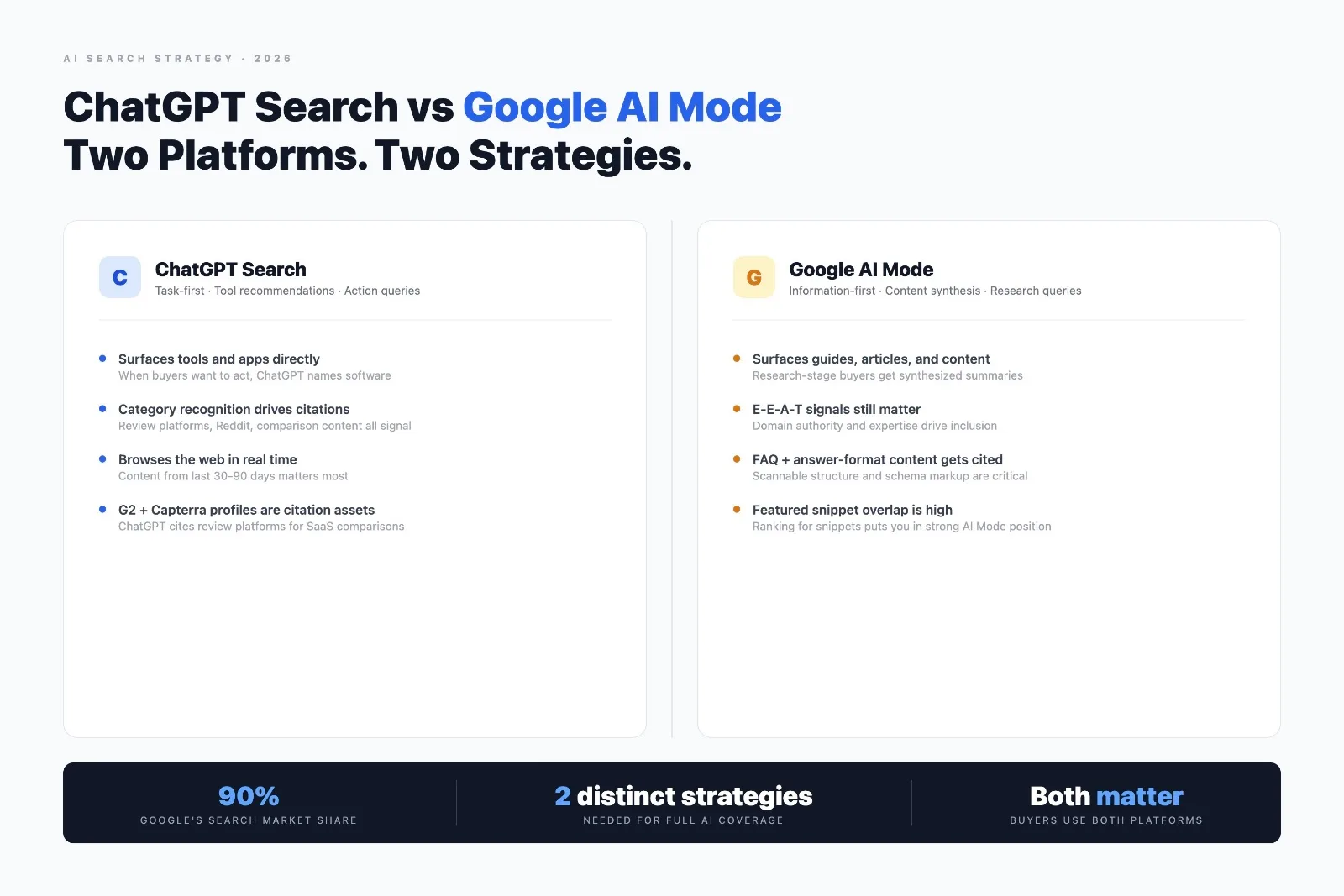
Research from BrightEdge, published in May 2026, analyzed thousands of real-world prompts across B2B technology and other industries. The finding was sharp: when users ask how to compare options, ChatGPT and Google AI Mode often agree. But when users want to act on something, the platforms diverge significantly. ChatGPT surfaces products, apps, and task-based tools directly. Google links to guides, articles, and institutional content.
For B2B SaaS brands, this split has real consequences. Your buyers are using both platforms. And if you’re running a single AI search strategy, you are optimizing for at most half of where they are.
This post breaks down the structural differences between the two platforms, what each one rewards, and how to build a content approach that works across both.
Why the Split Matters Now
Google still holds roughly 90% of global search market share. That doesn’t change overnight. But ChatGPT Search is growing fast, particularly among tech-savvy buyers who are comfortable with conversational interfaces.
In B2B technology specifically, the divergence is most visible on transactional queries. When a buyer asks “what tool should I use for [specific job],” ChatGPT tends to name software directly. Google tends to surface a comparison article or a list post.
This creates a situation where:
- If you want ChatGPT citations, you need to be a recognized, credible tool in your category
- If you want Google AI Mode citations, you need well-structured content that answers specific questions
Neither strategy cancels the other out. But they require different execution.
How ChatGPT Search Decides What to Cite
ChatGPT Search functions as a “trusted coach” for task-oriented queries. When a user asks it to help them do something specific, it doesn’t necessarily look for the most authoritative article. It looks for the most relevant and credible tool or resource.
Several factors influence ChatGPT citation behavior:
1. Category recognition. ChatGPT has strong categorical memory from its training data. Brands that appear frequently and positively in discussion forums, review sites, and comparison content tend to get surfaced. G2, Capterra, and ProductHunt matter here. So does Reddit. If your product category has an established set of known tools, you need to be in that mental model.
2. Direct, task-relevant positioning. ChatGPT responds well to content that explicitly answers “what tool does X.” Product pages that clearly state your capability, category, and use case outperform vague brand content. Schema markup with SoftwareApplication type is directly useful here.
3. Recency and web browsing. ChatGPT Search actively browses the web in real time. This means recent content matters. Blog posts, press mentions, and updated documentation from the last 30-90 days can appear in responses. Stale content gets stale citations.
4. Review platform presence. ChatGPT frequently cites G2, Capterra, and TrustRadius when users ask about B2B software. A strong G2 profile with recent reviews is effectively an AI citation asset.
How Google AI Mode Decides What to Cite
Google AI Mode (the successor to AI Overviews) works differently. It is built on Google’s existing search infrastructure, meaning it inherits much of Google’s traditional ranking logic, but applies a generative layer on top.
The key difference from standard Google search is how it handles informational versus transactional queries. AI Mode is particularly prominent on research-stage and comparison queries. It synthesizes content from multiple sources and presents a structured answer.
What gets cited in Google AI Mode:
1. E-E-A-T signals. Google still weighs Experience, Expertise, Authoritativeness, and Trustworthiness. Content that demonstrates first-hand knowledge, cites credible sources, and comes from an established domain gets surfaced more often. For a new SaaS brand, this means building E-E-A-T signals through consistent publishing, external links, and verifiable author credentials.
2. Answer-format content. AI Mode tends to pull from content that directly answers a question. A post titled “How to optimize your SaaS content for AI search” with a clear, scannable structure outperforms a thought leadership essay. Short paragraphs, descriptive subheadings, and FAQ sections all help.
3. Domain authority and backlinks. Unlike ChatGPT, Google AI Mode does weight traditional domain authority. Third-party links and press mentions contribute to whether Google includes your site in AI Mode citations.
4. Schema markup. Google’s crawlers and AI systems use structured data to understand content type, entity relationships, and factual claims. FAQPage, HowTo, and Article schema increase the probability of appearing in AI Mode summaries.
5. Featured snippet eligibility. Content that earns featured snippets often appears in AI Mode citations. The overlap is not 100%, but it is significant. If you’re ranking for a featured snippet, you are in a strong position for AI Mode.
The Strategic Implications for B2B SaaS
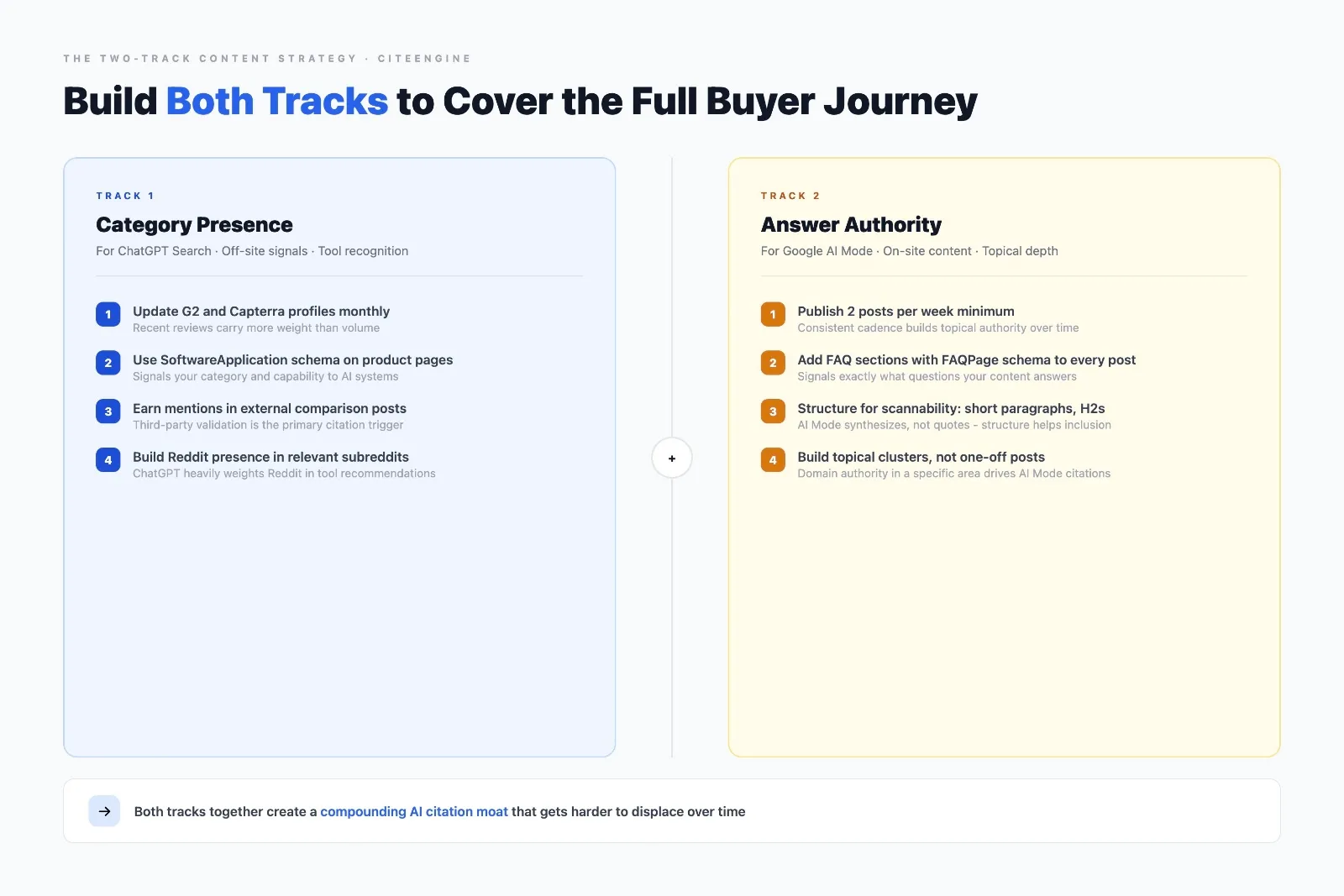
Given these differences, a smart content strategy for 2026 runs on two parallel tracks.
Track 1: Build category presence for ChatGPT citations
The goal here is to be recognized as a credible player in your category by the systems that aggregate signals into ChatGPT’s responses.
Actions: - Keep your G2 and Capterra profiles updated with recent reviews (reviews from the last 6 months carry more weight) - Publish product-focused content that clearly states your category, capability, and differentiation - Get mentioned in comparison posts on credible third-party blogs and publications - Use SoftwareApplication or WebApplication schema on your product pages - Maintain Reddit presence in relevant subreddits where your buyers discuss tools
This track is less about content volume and more about signal density. You want multiple credible sources saying roughly the same thing about your product’s category and capability.
Track 2: Build answer authority for Google AI Mode citations
The goal here is to own the informational content your buyers read while they research.
Actions: - Publish consistently on the questions your ICP is asking (2 posts per week minimum to compound) - Structure every post for scannability: short paragraphs, H2s that state the answer, bullet points - Add FAQ sections to every post (FAQPage schema signals to Google what questions your content answers) - Build topical depth in a cluster, not just one-off posts. AI Mode favors sites that have authority in a specific area - Earn backlinks through PR, data studies, and third-party mentions
This track is a longer game. Domain authority does not build overnight. But the compound effect means that early movers in a category build citation moats that become harder to dislodge.
Where Both Platforms Agree
Despite the divergence, there are several things that help with both ChatGPT Search and Google AI Mode simultaneously.
Clear, factual content. Both platforms reward specificity over vagueness. “CiteEngine monitors your brand’s presence across ChatGPT, Perplexity, and Google AI Overviews in real time” is more citable than “CiteEngine uses AI to boost your visibility.”
Verifiable statistics. Both systems use data points as citation anchors. A post with a specific, sourced statistic is more likely to be surfaced than one with general claims.
Consistent entity signals. Having your brand name, category, URL, and core positioning consistent across your website, review sites, social profiles, and third-party mentions helps both platforms understand what you are. This is entity building, and it is foundational for both.
Regular publishing cadence. Neither platform rewards dormancy. Fresh content signals that your site is active and that your information is current.
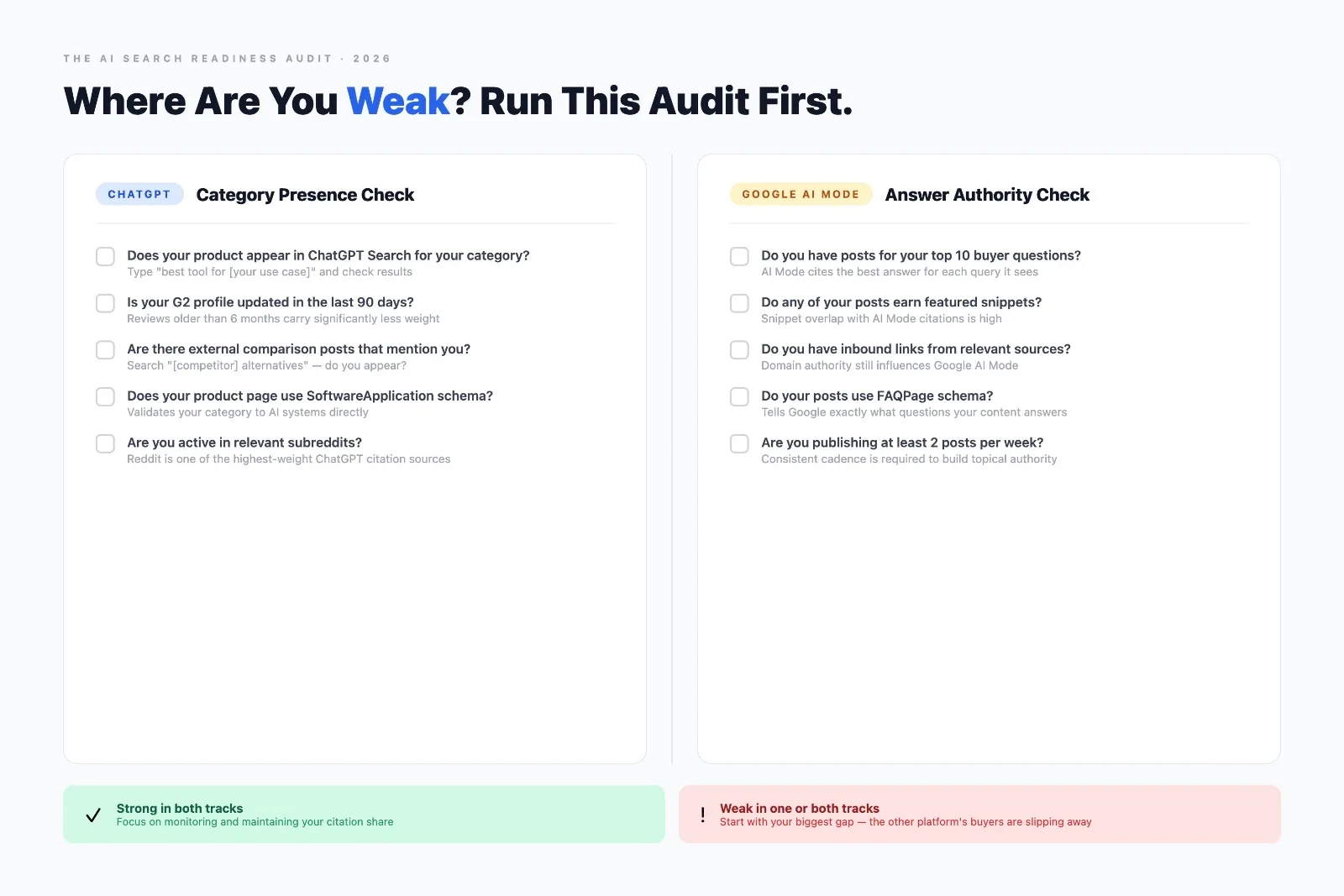
A Practical Content Audit: Which Track Are You Weak On?
Before building new content, it helps to know where your gaps are.
For ChatGPT readiness, ask: - Does your product appear when you type your category name into ChatGPT Search? - Is your G2 profile complete and updated in the last 90 days? - Are there any third-party comparison posts that mention you? - Does your product page use SoftwareApplication schema?
For Google AI Mode readiness, ask: - Do you have posts that directly answer the top 10 questions your buyers are searching? - Do any of your posts earn featured snippets? - Does your domain have inbound links from relevant, credible sources? - Do your posts use FAQPage schema?
If your answers lean heavily toward one track and not the other, that is where to invest next.
What This Means for CiteEngine Users
This split in AI search platforms is precisely what CiteEngine is built to track.
The platform monitors your citation presence across ChatGPT, Perplexity, and Google AI Overviews simultaneously. You can see which queries surface your brand, what sources are being cited instead of you, and where your presence is growing or declining over time.
Without measurement, the two-track strategy described above becomes guesswork. You’re publishing content and hoping it lands. With citation tracking, you know exactly which efforts are moving the needle and which aren’t.
If you haven’t checked your brand’s current citation footprint, the free AI Visibility Audit at www.citeengine.com shows you where you stand across all three major platforms in a single session.
The Bottom Line
ChatGPT Search and Google AI Mode are not competitors to each other. For most B2B buyers in 2026, they are complementary tools used at different moments in the research process.
ChatGPT tends to get used when buyers want to make a decision quickly. Google AI Mode gets used when they are still building understanding.
Your content strategy needs to serve both moments.
Brands that treat AI search as a single channel will optimize well for one platform and leave citation share on the table with the other. Brands that build parallel strategies, one focused on category recognition and review presence, the other on deep informational authority, will compound faster.
The window to build that moat is still open. Six months from now, it will be narrower.
Frequently Asked Questions
What is the main difference between ChatGPT Search and Google AI Mode? ChatGPT Search is conversational and task-oriented. It tends to recommend specific tools and resources when users want to take action. Google AI Mode is information-first. It synthesizes content from across the web and is most prominent on research and comparison queries. They cite different types of content and serve different buyer moments.
Does Google AI Mode use the same ranking signals as traditional Google search? Largely yes, with a generative layer added. Google AI Mode still weighs E-E-A-T signals, domain authority, and structured data. Content that ranks well in traditional Google search tends to have an advantage in AI Mode, though featured snippet-eligible content has the strongest overlap.
How do I know if my brand appears in ChatGPT Search? You can test manually by typing category-level queries into ChatGPT Search (“best tool for [your use case]” or “alternatives to [competitor]”). For systematic monitoring, platforms like CiteEngine track this automatically across multiple platforms and queries.
Can I rank in both ChatGPT Search and Google AI Mode with the same content? Partially. Well-structured, factual, and specific content helps with both. But ChatGPT citations are more influenced by off-site signals (review platforms, Reddit, third-party mentions), while Google AI Mode is more influenced by on-site content quality and domain authority. A complete strategy addresses both.
How often should I publish to maintain AI search presence? For Google AI Mode, consistent publishing matters. The recommended minimum is two posts per week to build topical authority over time. For ChatGPT citations, publishing cadence is less critical than ensuring review profiles and category signals are current. Both benefit from regular updates.
Does schema markup help with AI search citations? Yes. FAQPage schema is particularly effective for Google AI Mode. SoftwareApplication schema helps ChatGPT understand your product’s category and capability. Article schema with author markup supports E-E-A-T signals across both platforms. Schema should be treated as standard practice, not optional.
Monitor your brand’s presence across ChatGPT, Perplexity, and Google AI Overviews with the free AI Visibility Audit at www.citeengine.com